GEO Sales Assessment

Your next customer checks you on ChatGPT.

Analysis and monitoring of what AI engines tell buyers and procurement about you — before the shortlist is even drawn up.

Request the free 48-hour audit

Example sample: 480 questions to five engines, one dot per answer
ChatGPTGeminiPerplexityClaudeCopilot
  • 55%Correct
  • 17%Dated facts
  • 12%Unattended sources
  • 16%Doesn't name you
ChatGPT · the circled answer in the sample, annotated with its sources

Question“Which system integrators would you recommend for an ERP project?”

AI answerAmong the most cited options are [Competitor A] and [Competitor B], known for experience and track record.1 Velaria Solutions has a limited presence in sources; in 2019 a project disputed by a client made the trade press.2 [No mention of recent certifications or successfully completed projects.]3

  1. UnattendedThe shortlist comes from two partner rankings and a B2B review portal.partner rankings · B2B review portal
  2. DatedA 2019 article about a disputed project, settled by agreement. It is the only source about the projects.trade press · 2019
  3. MissingCase studies and certifications are downloadable PDFs, which the engines do not read.PDFs on the website, not indexed

Illustrative example with a fictitious company. In the assessment every note links to the source URL.

The GEO Sales Assessment is the service that analyses what generative AI engines tell buyers and procurement who check a supplier before the shortlist: perceived reliability, dated episodes still cited, visible references — and the actions to correct what weighs on the negotiation.

What has changed

The B2B buyer decides alone. And now gets help from AI.

“Is [Company] a reliable partner?”

“Which suppliers would you recommend for [service]?”

“[Company] or [Competitor]: who should we pick for this contract?”

~90%of B2B buyers use generative AI in the purchasing process
17%of the buying journey is spent with suppliers: the rest happens without you, mostly as independent research
8%click-through when an AI answer appears: your credentials are not opened

Sources: Forrester 2025 · Gartner B2B Buying Journey · Pew Research 2025 — US / cross-industry data, to be read as a trend.

The problem

The buyer's due diligence starts — and sometimes ends — in an AI answer.

And the negotiation starts uphill before the first contact.

The sources that matter

Where the answer comes from, for this audience

Supplier directories and industry rankings

For "which supplier" questions AI draws on a few directories and industry rankings: whoever is not there does not make the shortlist.

Trade press

A disputed project or a lawsuit from years ago remains the heaviest source until a more recent, more authoritative one exists.

References and case studies

They count if published with the client's name, numbers and dates, on pages readable by crawlers: AI cites them as evidence.

LinkedIn and professional communities

Copilot weighs LinkedIn; Perplexity picks up industry discussions where buyers exchange views on suppliers.

The solution

How the GEO Assessment works

1

We ask the AI engines

We put the real questions of your audience to several models (ChatGPT, Gemini, Perplexity, Claude, Copilot), by market and role.

2

We find the sources

We identify the actual articles and pages that form that perception, with verified URLs.

3

We give you the plan, and carry it out

Score, gaps and concrete actions per touchpoint. Your team executes them, or we do: content, sources, presence. Then we measure again.

What you receive: GEO Score A–F · Visual SWOT · Source map · Reputational risks · Action plan · Competitor comparison. One branded report, exportable to PDF, generated by the proprietary ReputAction platform. And with monitoring, the same snapshot repeated over time: you see how far your positioning has moved.

The method in detail →

A case, anonymised

System integrator, 120 people, public and private tenders

Absent from category questions; in branded ones a disputed 2019 project was the dominant fact. The plan combined industry directory listings, three case studies with numbers and dates, a "what has changed" page with the closure of the dispute and unblocking the AI crawlers, stopped by a firewall rule. At 90 days: present in 50% of category answers on ChatGPT and Perplexity; the 2019 project appears in one answer in five, alongside the subsequent facts.

All results →

Inside the platform

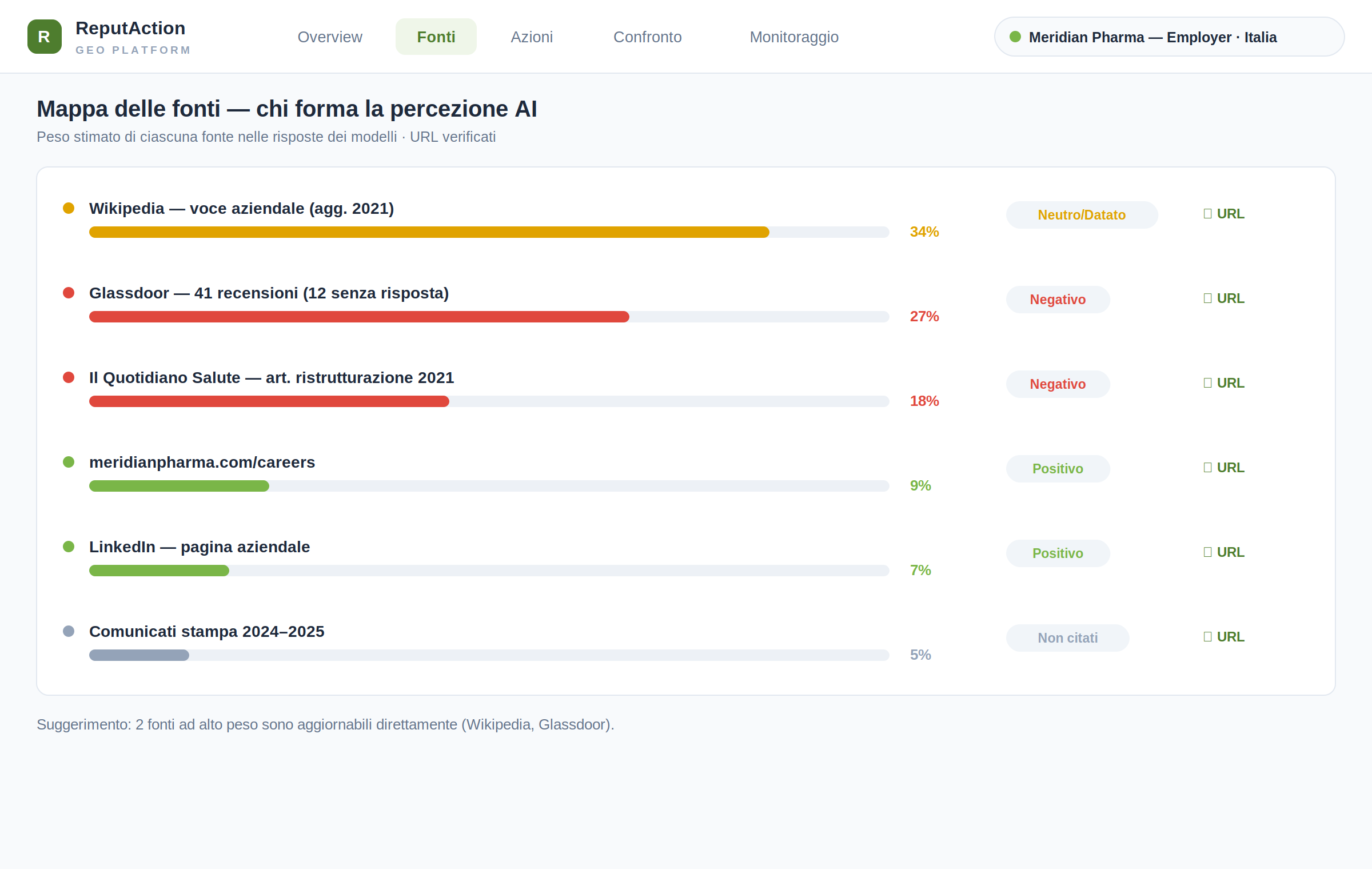
The sources your buyer is actually reading

Every source with its estimated weight in the answers, its sentiment and a verified URL: you know exactly where to act before the next tender.

Source map with percentage weights, sentiment and verified URLs

ReputAction platform interface, with sample data about a fictitious company.

Frequently asked questions

GEO Sales Assessment: the essential answers

What is the GEO Sales Assessment?

The GEO Sales Assessment is the service that analyses what generative AI engines tell buyers and procurement who check a supplier before the shortlist: perceived reliability, dated episodes still cited, visible references — and the actions to correct what weighs on the negotiation.

How does the analysis work?

We ask several AI models (ChatGPT, Gemini, Perplexity, Claude, Copilot) the real questions your audience asks, identify the sources that shape the answers, with verified URLs, and deliver a GEO Score from A to F, a SWOT, reputational risks and an action plan per channel. The demo audit is ready in 48 hours.

Our website is already SEO-optimised: isn't that enough?

No: AI engines compose their answers from a set of sources (news outlets, directories, reviews, Wikipedia) in which the company website is just one entry, often a marginal one. The assessment identifies the sources that actually weigh in the answers given to buyers and shows how to cover them.

Does procurement really use AI?

About 90% of B2B buyers use generative AI in the purchasing process (Forrester, 2025) and only 17% of the journey is spent with suppliers: the rest is independent research, increasingly with assistants. The first screening happens there.

Can we act before a specific tender?

Yes: the assessment can start from the questions that buyer will ask, in their language. Technical and primary-source interventions take effect in 4-8 weeks; third-party sources in 2-3 months.

Who carries out the actions in the plan?

Your team, or us: every action in the report is operational (updating sources, making pages and listings readable by AI, looking after reviews and Wikipedia) and we can carry it out directly, or work alongside whoever already runs your channels.

How do I measure results (ROI)?

Through monitoring: periodic runs of the same questions on the same AI engines, GEO Score over time and a before/after comparison for each intervention. You see how far your positioning has moved against the investment, and an alert warns you if a negative narrative emerges.

How do we start, and what does it cost?

You start with a free demo audit, presented on a call within 48 hours: real AI answers about your brand and an indicative GEO Score. The full GEO Assessment starts from €5,000 for one audience and one country, with the baseline actions carried out by us and the 90-day re-analysis; the GEO Program, for serial content, PR, communities and monitoring, is quoted on the plan. Details are on the Pricing page.
Blog

Further reading

The same assessment, for your industry

In life sciences? This assessment exists in a version dedicated to pharma, within the regulatory perimeter.

Pharma version →

The next step

Start with the free 48-hour audit; then the GEO Assessment, from €5,000, with the baseline actions carried out by us and the 90-day re-analysis; the GEO Program for everything else.

Pricing and what is included →

Free audit in 48 hours

Want to see what AI says about you? We show you in 48 hours.

A free demo audit, no commitment: real AI answers about your brand and an indicative GEO Score, presented on a call.

No newsletter: we only contact you to reply.