Life Sciences · GEO Sales Assessment

Your next customer checks you on ChatGPT.

Analysis and monitoring of what AI engines tell life sciences buyers and procurement about you — before the shortlist is even drawn up.

Request the free 48-hour audit

Example sample: 480 questions to five engines, one dot per answer
ChatGPTGeminiPerplexityClaudeCopilot
  • 52%Correct
  • 16%Dated facts
  • 14%Unattended sources
  • 18%Doesn't name you
ChatGPT · the circled answer in the sample, annotated with its sources

Question“Which European CDMOs would you recommend for small sterile batches?”

AI answerAmong the most cited options are [Competitor A] and [Competitor B], known for capacity and track record.1 Meridian BioServices has a limited presence in sources; in 2019 it received an FDA warning letter for a manufacturing site.2 [No mention of the case being resolved, recent certifications or the new plants.]3

  1. UnattendedThe shortlist comes from two CDMO directories and an analyst report.CDMO directories · industry report
  2. DatedThe 2019 FDA warning letter is the most cited source. The closure of the case in 2021 is not.fda.gov · trade press · 2019
  3. MissingNew plants and recent certifications are in press releases that no outlet read by the AI engines picked up.press releases not picked up

Illustrative example with a fictitious company. In the assessment every note links to the source URL.

The GEO Sales Assessment for life sciences is the service that analyses what generative AI engines tell those evaluating CDMOs, CROs and industry suppliers before the shortlist: dated warning letters still cited, invisible certifications, competitors recommended in your place — and the actions to correct it.

What has changed

The B2B buyer decides alone. And now gets help from AI.

“Is [Company] a reliable partner?”

“Which suppliers would you recommend for [service]?”

“[Company] or [Competitor]: who should we pick for this contract?”

~90%of B2B buyers use generative AI in the purchasing process
17%of the buying journey is spent with suppliers: the rest happens without you, mostly as independent research
8%click-through when an AI answer appears: your credentials are not opened

Sources: Forrester 2025 · Gartner B2B Buying Journey · Pew Research 2025 — US / cross-industry data, to be read as a trend.

The problem

The buyer's due diligence starts — and sometimes ends — in an AI answer.

And the negotiation starts uphill before the first contact.

The sources that matter

Where the answer comes from, for this audience

Warning letters and inspections

FDA, EMA, AIFA: AI cites them as dominant facts until the resolution is published in a readable form.

CDMO, CRO and supplier directories

For "which partner" questions AI draws on a few industry directories and rankings.

Certifications and production capacity

GMP, ISO, capacity and plants: they count if published in HTML with dates, not in brochures.

Trade press and conferences

Talks and articles with data are the third-party sources that move category answers.

The solution

How the GEO Assessment works

1

We ask the AI engines

We put the real questions of your audience to several models (ChatGPT, Gemini, Perplexity, Claude, Copilot), by market and role.

2

We find the sources

We identify the actual articles and pages that form that perception, with verified URLs.

3

We give you the plan, and carry it out

Score, gaps and concrete actions per touchpoint. Your team executes them, or we do: content, sources, presence. Then we measure again.

What you receive: GEO Score A–F · Visual SWOT · Source map · Reputational risks · Action plan · Competitor comparison. One branded report, exportable to PDF, generated by the proprietary ReputAction platform. And with monitoring, the same snapshot repeated over time: you see how far your positioning has moved.

The method in detail →

A case, anonymised

European CDMO, 2019 warning letter resolved in 2021

In "which CDMOs for sterile batches" questions the company did not appear; in branded ones the warning letter was the first fact cited. The plan published the resolution of the case with institutional references, made certifications and capacity readable in HTML, listed the company in industry directories and secured a technical article with data on the new plants. At 90 days the company appears in 55% of category answers and the warning letter is cited with its date and resolution.

All results →

Inside the platform

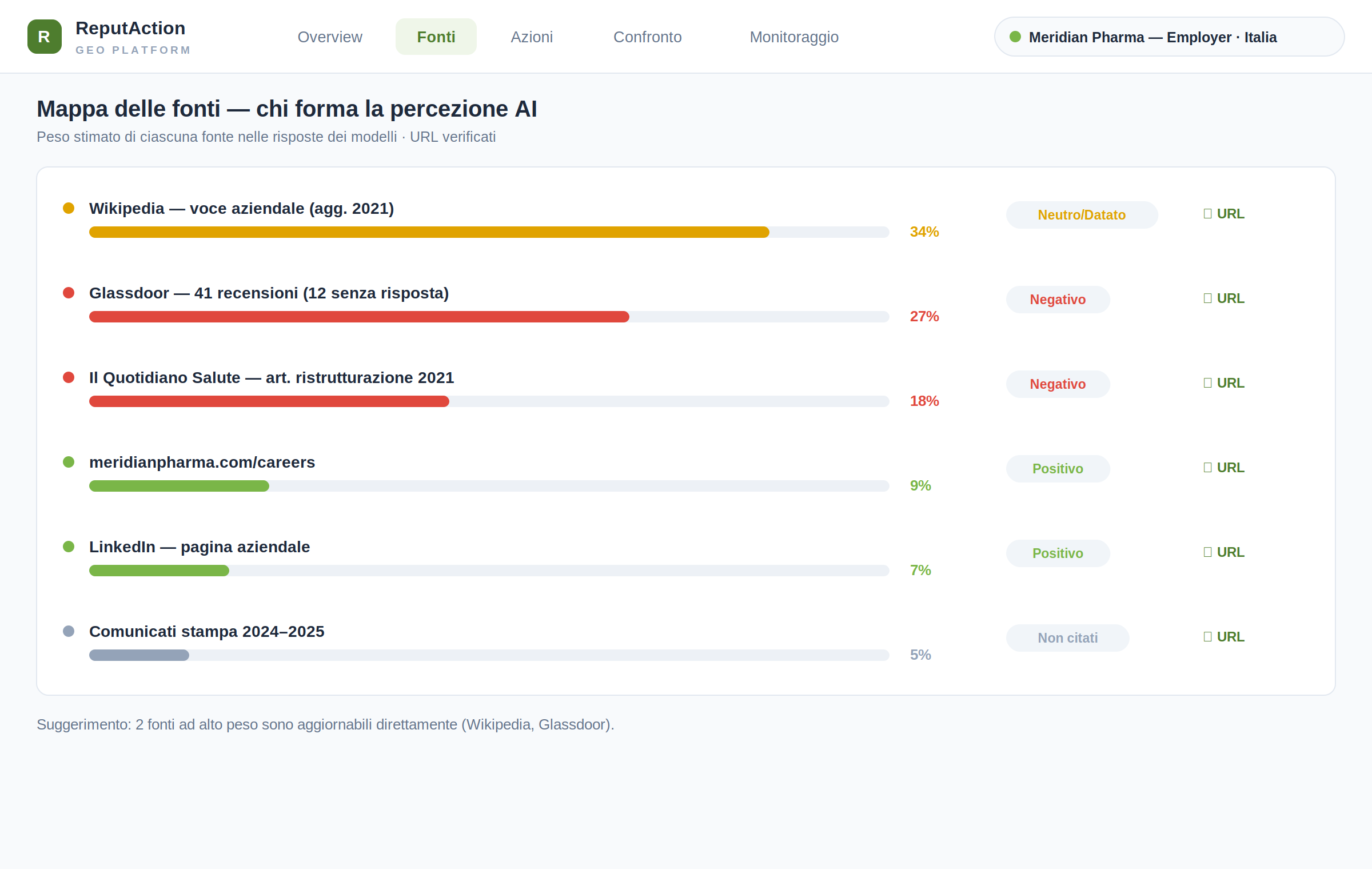
The sources your buyer is actually reading

Every source with its estimated weight in the answers, its sentiment and a verified URL: you know exactly where to act before the next tender.

Source map with percentage weights, sentiment and verified URLs

ReputAction platform interface, with sample data about a fictitious company.

Frequently asked questions

GEO Sales Assessment for Life Sciences: the essential answers

What is the GEO Sales Assessment for Life Sciences?

The GEO Sales Assessment for life sciences is the service that analyses what generative AI engines tell those evaluating CDMOs, CROs and industry suppliers before the shortlist: dated warning letters still cited, invisible certifications, competitors recommended in your place — and the actions to correct it.

How does the analysis work?

We ask several AI models (ChatGPT, Gemini, Perplexity, Claude, Copilot) the real questions your audience asks, identify the sources that shape the answers, with verified URLs, and deliver a GEO Score from A to F, a SWOT, reputational risks and an action plan per channel. The demo audit is ready in 48 hours.

Does it apply to CDMOs, CROs and service providers?

Yes, it is the main use case: whoever selects a life sciences partner checks track record, inspections and certifications, and now asks the AI too. The assessment shows what a buyer evaluating you hears, with the exact sources.

Does AI read the FDA and EMA databases?

Yes, and considers them authoritative. If an inspection or a warning letter is public, it must be accompanied by equally readable sources on its resolution.

Does it apply to service and technology suppliers too?

Yes: CROs, regulatory software providers, logistics, clinical services. Category questions work the same way.

Who carries out the actions in the plan?

Your team, or us: every action in the report is operational (updating sources, making pages and listings readable by AI, looking after reviews and Wikipedia) and we can carry it out directly, or work alongside whoever already runs your channels.

How do I measure results (ROI)?

Through monitoring: periodic runs of the same questions on the same AI engines, GEO Score over time and a before/after comparison for each intervention. You see how far your positioning has moved against the investment, and an alert warns you if a negative narrative emerges.

How do we start, and what does it cost?

You start with a free demo audit, presented on a call within 48 hours: real AI answers about your brand and an indicative GEO Score. The full GEO Assessment starts from €5,000 for one audience and one country, with the baseline actions carried out by us and the 90-day re-analysis; the GEO Program, for serial content, PR, communities and monitoring, is quoted on the plan. Details are on the Pricing page.
The same assessment, for your industry

Not in life sciences? The same assessment exists in a standard version, for every industry.

Cross-industry version →

The next step

Start with the free 48-hour audit; then the GEO Assessment, from €5,000, with the baseline actions carried out by us and the 90-day re-analysis; the GEO Program for everything else.

Pricing and what is included →

Free audit in 48 hours

Want to see what AI says about you? We show you in 48 hours.

A free demo audit, no commitment: real AI answers about your brand and an indicative GEO Score, presented on a call.

No newsletter: we only contact you to reply.