Life Sciences · GEO Employer Assessment

What does AI say about you as an employer?

Analysis and monitoring of your reputation in the answers of ChatGPT, Gemini and Perplexity — the first place researchers, medical advisors and MSLs look for you.

Request the free 48-hour audit

Example sample: 480 questions to five engines, one dot per answer
ChatGPTGeminiPerplexityClaudeCopilot
  • 52%Correct
  • 18%Dated facts
  • 13%Unattended sources
  • 17%Doesn't name you
ChatGPT · the circled answer in the sample, annotated with its sources

Question“What is it like to work at Meridian Pharma?”

AI answerMeridian Pharma is a pharmaceutical company. In 2021 it went through a restructuring with job cuts.1 Some online reviews mention a work-life balance that is not always ideal and slow decision-making.2 [No mention of R&D, purpose, DE&I programmes or recent awards.]3

  1. DatedThe 2021 restructuring is told by two articles. The 2024 research hires do not appear.trade press · 2021
  2. UnattendedEmployee reviews stuck at 2022, none with a reply from the company.glassdoor.com · indeed.com
  3. MissingDE&I programmes and employer awards are only on the careers site, which the AI engines rarely cite.careers site, not cited

Illustrative example with a fictitious company. In the assessment every note links to the source URL.

The GEO Employer Assessment for life sciences is the service that analyses what generative AI engines say about a pharmaceutical company as an employer: the perception researchers, medical advisors and MSLs receive from ChatGPT, Gemini and Perplexity, the sources it comes from and the actions to correct it.

What has changed

Before applying, talent no longer opens Google. It asks the AI.

“What is it like to work at [Company]?”

“Is it a good place for a researcher / a medical advisor?”

“[Company] or [Competitor]: where should I go?”

21%of candidates use AI to research a company before applying
8%click-through when an AI answer appears (vs 15% without): your Careers page is not opened
35%below talent needs: the life sciences talent gap

Sources: Insight Global AI in Hiring 2025 · Pew Research 2025 · AMS / CSG Talent Life Sciences 2025 — US / cross-industry data, to be read as a trend.

The problem

Your Careers page is no longer read. It is summarised — by a machine.

And nobody in the company is watching what it answers.

The sources that matter

Where the answer comes from, for this audience

Glassdoor and Indeed, by role

Researchers, medical advisors and MSLs read reviews for their own role: AI summarises them by professional family.

News on restructurings and site closures

In pharma, reorganisations make the news and remain sources for years, even after new investments.

LinkedIn and scientific communities

Company page, R&D posts, profiles of scientific leads: the signals technical profiles look for.

Pages on R&D, purpose and DE&I

They count if they contain dated facts: public pipeline, training hours, named programmes.

The solution

How the GEO Assessment works

1

We ask the AI engines

We put the real questions of your audience to several models (ChatGPT, Gemini, Perplexity, Claude, Copilot), by market and role.

2

We find the sources

We identify the actual articles and pages that form that perception, with verified URLs.

3

We give you the plan, and carry it out

Score, gaps and concrete actions per touchpoint. Your team executes them, or we do: content, sources, presence. Then we measure again.

What you receive: GEO Score A–F · Visual SWOT · Source map · Reputational risks · Action plan · Competitor comparison. One branded report, exportable to PDF, generated by the proprietary ReputAction platform. And with monitoring, the same snapshot repeated over time: you see how far your positioning has moved.

The method in detail →

A case, anonymised

Pharmaceutical company, 1,200 employees in Italy, R&D roles unfilled

Answers to "what is it like to work as a researcher" cited a 2021 restructuring and dated reviews; R&D and DE&I programmes never appeared. The plan, within the regulatory perimeter, updated Wikipedia and Wikidata, published a facts page on R&D and training, replied to reviews and secured an interview with the head of R&D in the trade press. At 90 days presence went from 45% to 70% and the answers cite the public pipeline and the training programmes.

All results →

Inside the platform

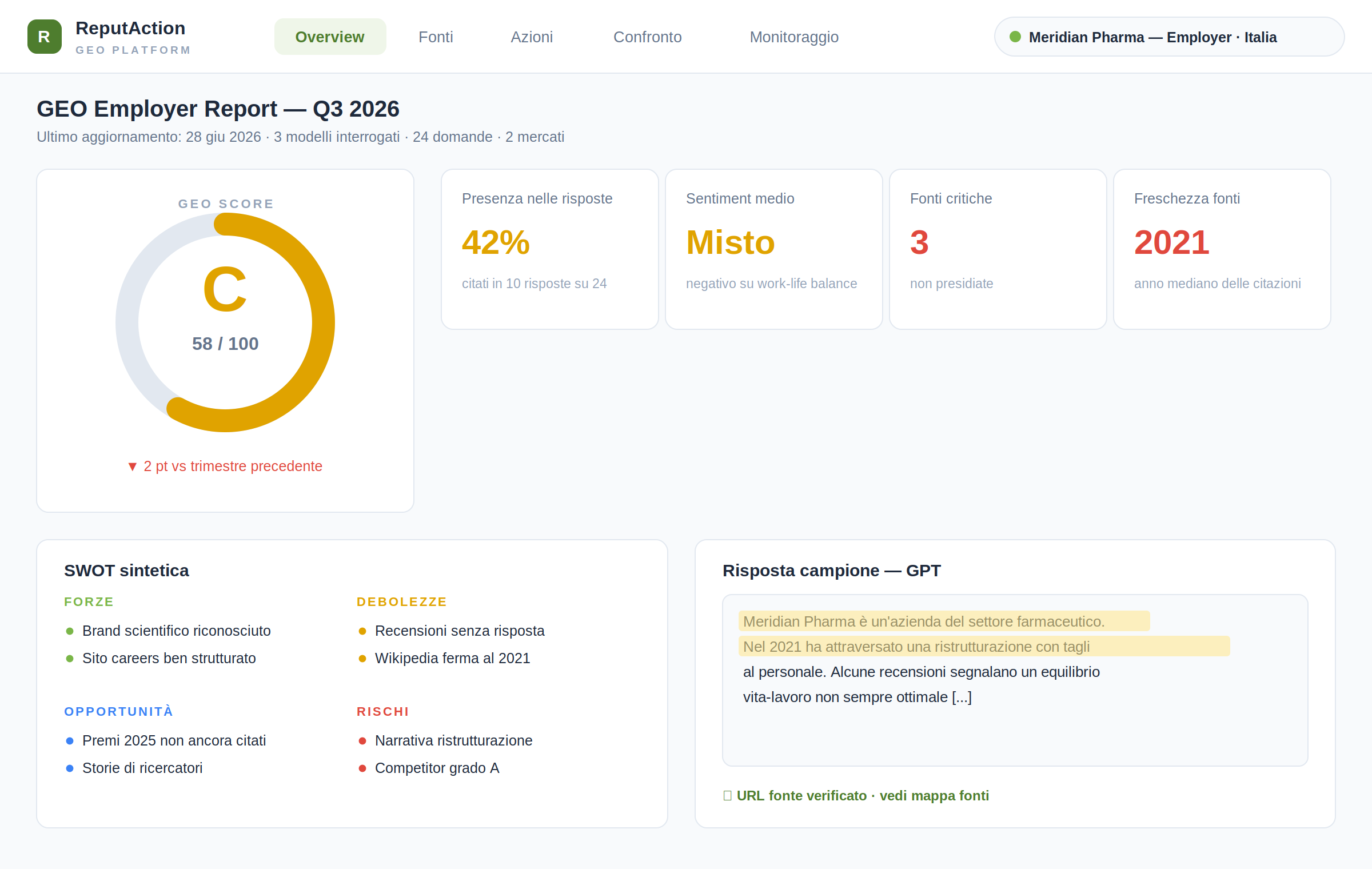
The Employer report, in one view

GEO Score, presence and sentiment KPIs, SWOT and sample answers with verified sources: the full picture of how AI describes you to candidates.

GEO Employer report dashboard: score C 58/100, KPIs, SWOT and sample answer

ReputAction platform interface, with sample data about a fictitious company.

Frequently asked questions

GEO Employer Assessment for Life Sciences: the essential answers

What is the GEO Employer Assessment for Life Sciences?

The GEO Employer Assessment for life sciences is the service that analyses what generative AI engines say about a pharmaceutical company as an employer: the perception researchers, medical advisors and MSLs receive from ChatGPT, Gemini and Perplexity, the sources it comes from and the actions to correct it.

How does the analysis work?

We ask several AI models (ChatGPT, Gemini, Perplexity, Claude, Copilot) the real questions your audience asks, identify the sources that shape the answers, with verified URLs, and deliver a GEO Score from A to F, a SWOT, reputational risks and an action plan per channel. The demo audit is ready in 48 hours.

Does it apply to scientific and regulatory profiles too?

Yes: researchers, medical advisors, MSLs and regulatory affairs use AI like any other candidate. The assessment asks the AI the typical questions of these roles, in the industry's own language, and measures what they hear about you.

Do you stay within the regulatory perimeter on employer branding too?

Yes: the analysis concerns the company as an employer and does not touch the promotion of medicines. The sources acted upon are reviews, news, LinkedIn, institutional pages.

Do you also cover regulatory and medical roles?

Yes: the assessment uses questions per role family (R&D, medical, regulatory, market access, commercial) in the industry's language.

Who carries out the actions in the plan?

Your team, or us: every action in the report is operational (updating sources, making pages and listings readable by AI, looking after reviews and Wikipedia) and we can carry it out directly, or work alongside whoever already runs your channels.

How do I measure results (ROI)?

Through monitoring: periodic runs of the same questions on the same AI engines, GEO Score over time and a before/after comparison for each intervention. You see how far your positioning has moved against the investment, and an alert warns you if a negative narrative emerges.

How do we start, and what does it cost?

You start with a free demo audit, presented on a call within 48 hours: real AI answers about your brand and an indicative GEO Score. The full GEO Assessment starts from €5,000 for one audience and one country, with the baseline actions carried out by us and the 90-day re-analysis; the GEO Program, for serial content, PR, communities and monitoring, is quoted on the plan. Details are on the Pricing page.
Blog

Further reading

The same assessment, for your industry

Not in life sciences? The same assessment exists in a standard version, for every industry.

Cross-industry version →

The next step

Start with the free 48-hour audit; then the GEO Assessment, from €5,000, with the baseline actions carried out by us and the 90-day re-analysis; the GEO Program for everything else.

Pricing and what is included →

Free audit in 48 hours

Want to see what AI says about you? We show you in 48 hours.

A free demo audit, no commitment: real AI answers about your brand and an indicative GEO Score, presented on a call.

No newsletter: we only contact you to reply.